
The Record in the Window
On The Rolling Stones' Let It Bleed

I’ve just finished Stanley Booth’s The True Adventures of The Rolling Stones, which follows the band across their 1969 American tour and ends at the Altamont Free Concert. It’s a stunning book. Booth’s account of the festival is among the most feverish and immersive pieces of music writing I’ve ever read, treating the music and the violence as part of the same weather system—something you’re forced to witness. By the end, it’s hard not to come away feeling a little shaken and disturbed.
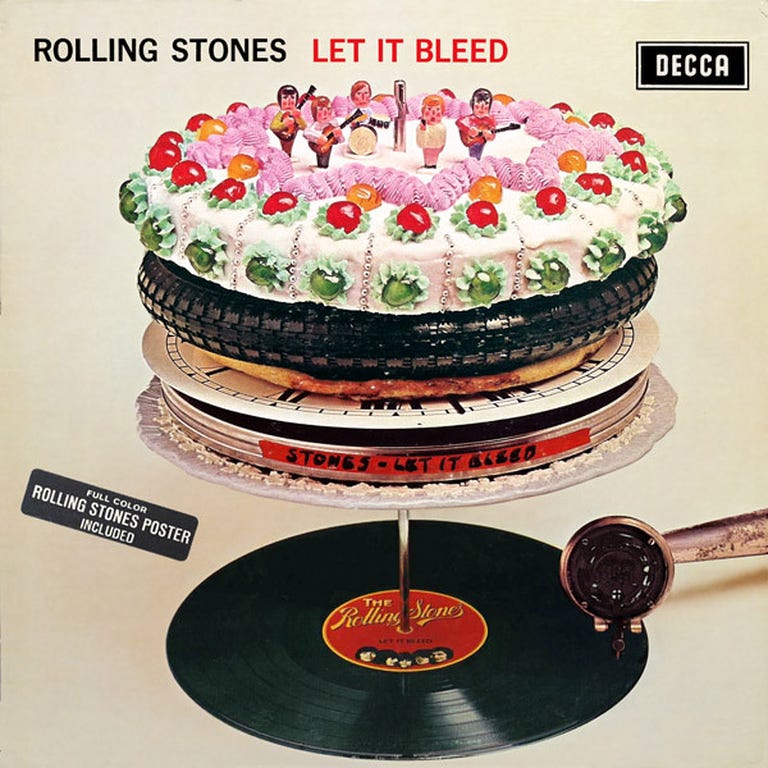
After finishing Booth’s book, I found myself revisiting the Stones’ catalogue—particularly Let It Bleed, which came out a month before Altamont. It’d been a while since I’d heard it, but hearing it again took me back twenty years, to when I was working as a sandwich artist at Subway. One day, a vinyl copy appeared in the Oxfam window across the road from the shop in Ormskirk. I’d notice it while cleaning the seating area, or when I passed on the way to Tesco further up Church Street. It hung in the window—Delia Smith’s cake on the cover, balanced above a turntable—facing out onto the street, while I made sandwiches and watched people pay and move on.
By the end of the week, I knew I was going to buy it. I just didn’t have the money yet. I was paid fortnightly back then, and until my next payday, all I could do was glance at it in the window and hope nobody else took it first. It was the first time I wanted a record before I could afford it, and there was an ache in knowing anyone else could walk in and buy it. At that point, I’m not even sure if I’d heard the album—I just knew I was drawn to it and wanted it badly.
When payday arrived, I bought the record for £40, which felt like a lot of money to me at the time. It turned out to be a first-press stereo copy with the poster still inside, an unboxed Decca label on the centre, and the original sticker on the front, making it much rarer than I realised. It was the sort of copy I would’ve wanted now, even though I didn’t know anything about record collecting back then. Once it was in my hands, I just knew it was mine and carried it home carefully.
For a few weeks, I played it every Friday evening in my bedroom on the hi-fi I’d inherited from my nan and grandad. My family would be at our chalet in Wales, and I’d lie on my bed smoking and listening to music before going out later that night. It felt like a private routine. My family didn’t know I smoked. Back then, hiding cigarettes felt like the dangerous part, and I thought I was getting away with it until my mum pulled the bed out one day and found a pile of empty packets I’d hidden behind my bed after nights out.
Let It Bleed was my first real introduction to the Stones. It was one of the first records I ever owned, and I played it constantly, especially before going out. It felt like part of getting ready—like putting on makeup. Buying that record was the start of an obsession that would crystallise around that time in my life. It’s still my favourite Stones album, and over time “Gimme Shelter” became my favourite song full stop.
I don’t have the record anymore. It went missing at a house party my housemates and I threw in Leeds. I’d locked my bedroom door, but someone still managed to get in and help themselves to a few records. The house was rammed—the sort of party where people drifted in and out of rooms, and nobody was quite in charge of what belonged to whom. I never found out who took them. One of them was Love’s Da Capo—another rare record I’d paid £100 for. That suggested at least some taste.
Buying another copy of a record you’ve already owned is galling. You’re not really replacing it; you’re admitting that the first one is gone. I bought the 50th-anniversary edition of Let It Bleed in 2019 because I wanted the album again, but I’m still looking for the one I lost. Usually, when I find a copy, the sleeve is worn, the poster is missing, or it’s too expensive. None of that stops me, though. Someday I’ll find it, or I’ll finally accept that I won’t.
Losing records isn’t like losing other things. When a record goes missing, the version of yourself who lived with it goes too. The one I had knew where it lived, which shelf it sat on, and the routines I built around it. The record I own now knows none of that. All of it belonged to the copy I lost. That’s the difference between owning a record and having lived with one—between something you put on and something that became part of your life.
Now, when I see a copy with a clean sleeve or a stereo pressing with the poster still inside, I pause. I don’t think about playing it. I think about whether it could be mine again—the shock of finding something I didn’t choose to give up. Most of the time, it isn’t.
💫 If you enjoyed this piece, consider subscribing or sharing it with someone. Want to support this work directly? Become a paid subscriber or leave a tip here. 💫
Fantastic piece. I never thought about why it feels so unpleasant buying a new copy of a record you've owned before, but that's explained it beautifully.
wowieee this is good. i need to read that book. i LOVE the gimmie shelter movie